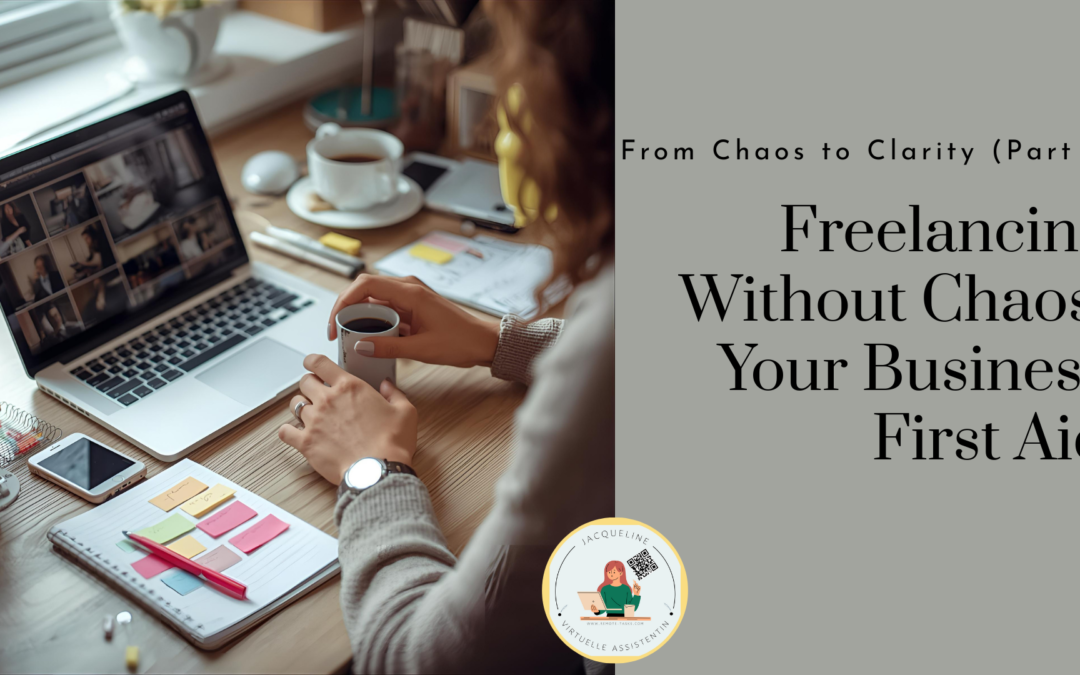
“I Need Help. Now.”
At some point, this moment arrives. Not loudly. Not dramatically. More quietly – and with exhaustion. The moment when you’re sitting in front of your laptop, looking at your to-do list, and you know: This can’t go on like this. Your business is running, but the lightness has been lost somewhere between deadlines, emails, and expectations.
So you do what many self-employed people do at this stage: you bring freelancers into your business. For social media, tech, bookkeeping, design, or copywriting. Finally delegating tasks. Finally not carrying everything alone. The hope: relief. And yes – in the short term, it often feels right.
But soon you realize that help alone doesn’t automatically create clarity. Instead of less work, there’s more coordination, more questions, more back-and-forth. Collaboration suddenly feels more complicated because no one ever defined how collaboration is actually supposed to work. This is where it becomes clear why simply handing off tasks isn’t enough. Structuring collaboration is the crucial step if delegation is meant to truly relieve you. Without clear processes, even well-intentioned help quickly turns into delegation with chaos – producing the exact opposite of what you hoped for. This is where the real talk begins. Because getting help is the right move.
But help without structure can cost more energy than it gives back.
Why Freelancers Are Often the First Logical Step
The fact that you turn to freelancers at this point is no coincidence. It’s a completely understandable decision. You want relief, but no long-term commitments. You need support, but as flexibly as possible. And you already have specific tasks in mind that you can no longer – or no longer want to – handle on your own. Freelancers promise exactly that: targeted support, specialized expertise on demand, quick help without major hurdles. One person handles social media, another tech, another design or bookkeeping. You buy in expertise where you need it – and still keep control.
Especially after a phase of constant stress, this feels right. You don’t have to onboard someone like a full-time employee, make long-term decisions, or build a team. You delegate tasks and hope the pressure will disappear with them. For many, this is the first moment they feel: I’m finally doing something for myself and my business. And honestly: in many cases, it works – at least for a while. Freelancers can be incredibly valuable. They bring expertise, fresh perspectives, and often exactly the support you need at that moment. The problem is rarely them.
When Relief Suddenly Creates More Work
This is where things start to shift for many people. You’ve brought in help, delegated tasks – and yet your daily life doesn’t feel lighter. Quite the opposite. Sometimes it even feels like you’re spending more time coordinating than you used to spend doing the work yourself. Suddenly, conversations run across multiple channels at once. A question comes via email, feedback via WhatsApp, an update somewhere in a tool you only wanted to “test quickly.” Files exist in multiple versions, responsibilities aren’t fully clear, and you explain the same task for the third time – just worded slightly differently.
What many underestimate is this: as soon as more than one person is involved, coordination effort automatically increases. And if there are no clear processes, no central places for information, and no clear agreements, all of that lands with one person. With you. You become the hub for everything. You explain, remind, follow up, and connect the dots. You answer questions, organize information, and keep the overview – on top of your actual work. The tasks may be outsourced, but the responsibility remains entirely yours.
This is when something important becomes clear: the support itself isn’t the problem. The tasks are delegated, the expertise is there – and yet your days don’t feel calmer. The issue isn’t the quality of the work, but how collaboration is organized. As soon as multiple people are involved, good intentions are no longer enough. Information needs to be accessible. Responsibilities must be clear. Processes need to be transparent. Without this shared foundation, additional coordination becomes inevitable – and it almost always ends up with the person who wants (or has) to keep the overview. Delegation works technically, but not relievingly. It shifts work instead of reducing it. And that’s exactly why the feeling remains that, despite all the help, you’re still the one holding everything together.
Real Talk: Why Coordination Without Structure Doesn’t Work
Freelancers can take over tasks – but they don’t coordinate themselves. And this is where many self-employed people get stuck. As soon as multiple people are involved, you don’t just need help, but leadership, structure, and a shared framework. What happens otherwise probably sounds familiar: Everyone works in their own system. Files are scattered, agreements happen across different channels, questions pop up randomly. You are the only constant – and automatically become the coordination point for everything.
At this stage, ad-hoc help is no longer enough. What’s needed is a coordinating role and a central system that everyone uses. This is where a virtual assistant shows their real strength: not as another task executor, but as a structuring interface. Someone who sets up a project management tool that fits your business, defines clear file structures, and establishes where things belong, how work is done, and which channel is used for what. One tool. One filing system. Clear rules.
And yes – this only works if it’s binding. If it’s clear that all freelancers work within this system – not according to personal preference, but based on a shared standard. That’s what relieves you: information is no longer searched for, but found. Questions are bundled. Tasks are prepared instead of constantly re-explained. The VA doesn’t just organize – they also ensure implementation. They make sure processes are followed, files are stored correctly, and collaboration actually works – without you having to step in all the time.
This is how ad-hoc help turns into real relief. Not through more people, but through clear structure and clear responsibility.
The Turning Point: Designing Collaboration Instead of Continuing to Improvise
At this point, many realize that it’s no longer about reacting faster or bringing even more people on board. What’s truly missing is a shared system of collaboration. And that system doesn’t happen by accident – it’s created by consciously taking the time to build it. Real relief often starts right here: when you stop simply passing on tasks and instead define how you work together – together with a virtual assistant or a central coordination role. Where files are stored. Which channel is used for communication. Who has access to what – and who doesn’t.
This includes a shared filing system that everyone understands. A central email address for freelancers or the VA to register tools without using personal logins. Team accounts instead of individual access. A properly set up password manager to handle permissions securely and clearly. And a project management tool that doesn’t just exist, but is actually used – by everyone involved. At first glance, this sounds like extra effort. And yes, it takes time. But it’s time you invest once – and then gain back every single day. Because suddenly, you’re no longer explaining things five times. Information is easy to find. Tasks run more smoothly. And collaboration finally feels the way you hoped it would: supportive instead of draining.
For many, this is the real turning point. Not because everything becomes perfect overnight, but because you stop improvising and start intentionally designing your business. Structure stops being a limitation – and becomes the foundation for lightness, growth, and genuine relief.



About the author
I am Jacqueline, a self-employed virtual assistant, family manager and until recently a student on a distance learning Bachelor of International Management program.
During my time as an executive assistant, I realized that I like planning, organizing and structuring and that I have a talent for making other people’s lives “administratively” easier.
My mission as a VA is to give my clients more freedom, ease and time through my support – for a better work-life balance!
I am structured and organized and always have a smile on my face. I can familiarize myself with new software and systems very quickly and not only think about processes, but also like to develop them further (with you).
If you would like to know more about my background and my WORK – LIFE – BALANCE, please have a look at the page That’s me!over